
We offer LPG storage tanks for sale that can be installed either as standalone units or integrated into a larger tank park, depending on your specific needs. CGH tanks are tailored to individual requirements while ensuring efficient operation and full compliance with legal and environmental standards. Whether you require underground LPG tanks for optimized space utilisation or aboveground tanks for easier access and maintenance, CGH provides robust carbon-steel vessels and sumps that are corrosion-protected and equipped with unique safety fittings.
LPG storage tanks in underground, mounded and aboveground variants are available in volumes from 9.1 m3 to 100 m3. LPG tanks are carbo steel designed. They meet safety requirements regarding the storage of propane, butane and a mixture of these gases. They hold valid permissions issued by a notified body for pressure devices subject to directive 2014/68/EU based on EN 13445 or AD2000.
LPG tanks are intended to store products:
- For heating in home and industrial systems
- On petrol stations for LPG refuelling points
- On LPG depots and customs warehouses
As a standard, LPG tanks for petrol stations are equipped with cut-off fittings, measurement and safety fittings. Optionally, they are fitted with sumps for tank collection units, i.e. LPG modules (LPG refuelling points on petrol stations) and control and measurement fittings such as magnetostrictive and radar probes or Rochester Senior or Rochester Magnetel level gauges.
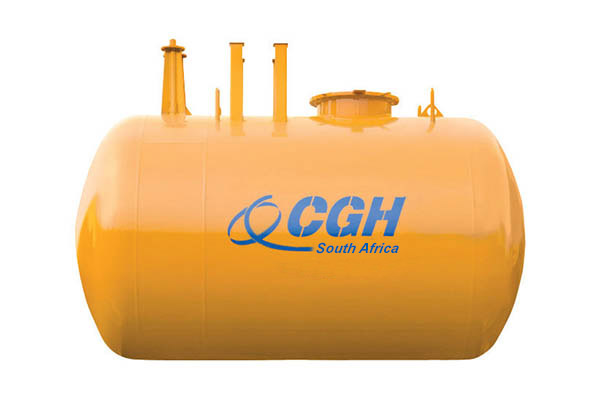
CGH South Africa specializes in designing and producing robust pressurized storage vessels for all types of liquids. CGH South Africa offers underground and aboveground pressurized vessels intended for industrial and heating purposes. CGH South Africa LPG tanks are equipped with various safety fittings as per clients’ requirements. CGH South African has the LPG solution to best suit your business.
LPG storage capacity
CGH South Africa bulk containers for liquids have a wide range of applications and is well suited for heating both domestic and industrial purposes. Made from high-quality materials and are available in various volumes from 9 m3 to 100 m3. CGH South Africa is fully compliant with health and safety regulations, offering competitive pricing, excellent customer service and safe delivery.
LPG application
CGH South Africa’s LPG bulk storage tanks provides ultimate flexibility for the best solution to suit your needs.
Underground LPG storage provides hidden off-grid gas supply while providing space saving. Aboveground LPG storage provides easy installation, which is a great fit for many of our customers. CGH South Africa offers LPG storage tanks made of carbon steel and are equipped with access manholes with various fittings. CGH South Africa meets the safety requirements for propane and butane storage. For more information on specifications and other technical data select one of the variants. We also offer different components, piping systems and composite product accessories.


What is an LPG flex pipe?
LPG flex pipes are used to transfer the liquid phase of gas between the tank and the receiver, such as a dispenser or evaporator. Available in sizes DN20 and DN25, our LPG-FLEX pipes are designed for underground installation in a single, continuous section. Their flexibility enables quick and simple installation on site. Compared to their steel counterparts, flexible gas pipes eliminate the need for more precise and costly welding and offer smaller pressure loss and exceptional longevity.
Is LPG the same as propane? What is LPG used for?
Propane is a type of LPG, but not all LPG is propane – LPG stands for liquefied petroleum gas and is a component of natural gas, which consists primarily of propane, butane, or a mixture of both. LPG is used across all industries as an energy source – from crop drying and industrial processing to commercial kitchens, heating, and vehicle fuel. CGH South Africa’s LPG bulk storage tanks provide exceptional flexibility, allowing you to choose the solution that best fits your unique needs. We specialise in pressurised vessels that need to withstand the test of time in the most demanding conditions, such as petrol stations, refuelling points or LPG modules, depots and customs warehouses.
Can LPG exposure affect my health or the environment?
You may be exposed to it when using LPG-powered appliances, such as ovens, grills, heaters, boilers or aerosols, but safe exposure levels are regulated by law and are well below those that cause harm. However, LPG can become threatening when mismanaged – health effects depend on the dose, duration, and form of exposure. While skin contact with escaping liquefied gas can cause frostbite, inhalation of high concentrations can cause nausea, breathing or heart problems and even death. Moreover, LPG is highly-flammable and rapidly broken down in the environment once released to air. That’s why CGH puts special emphasis on safety regulations, e.g., compliance with directive 2014/68/EU based on EN 13445 or AD2000 for pressure devices.